Previously
Rudolfinum
September 23
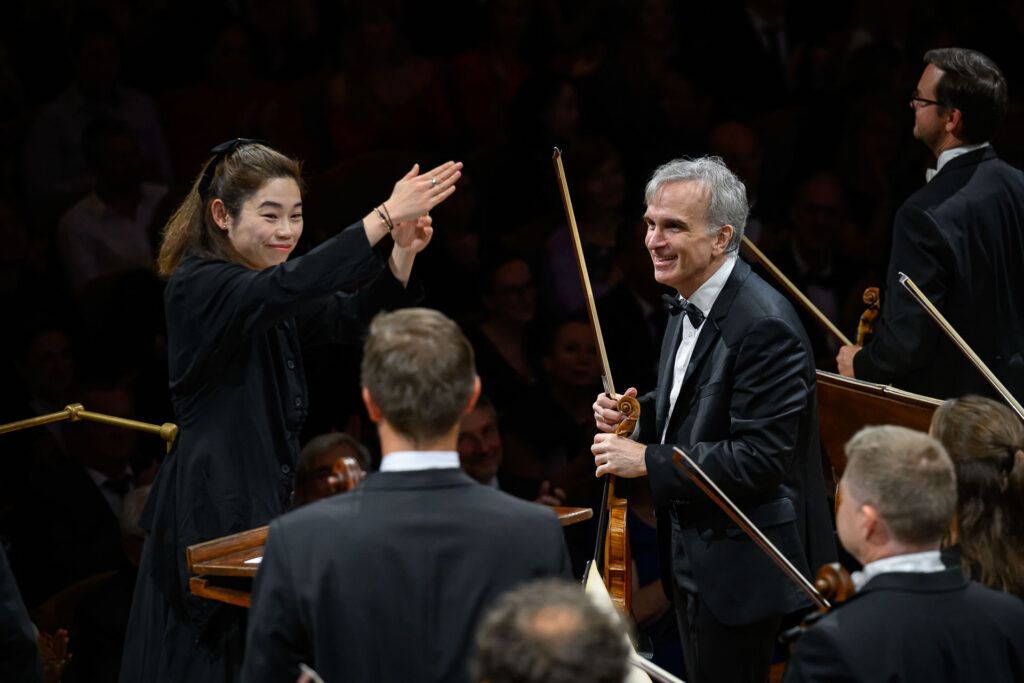
Chan and Shaham enjoying some well-deserved accolades (Photo by Petra Hajská)
The Dvořák’s Prague festival closed out in style, with conductor Elim Chan eliciting a fresh, energetic performance from the Czech Philharmonic, and virtuoso violinist Gil Shaham weaving his usual magic spell. The program put Czech music in an illuminating context, offered a high caliber of musicianship and gave the audience a chance to see one of classical music’s rising stars at work.
Chan pulled off a remarkable feat, maintaining the orchestra’s signature sound while giving it a cosmopolitan burnish. Overall the music was bright and airy, with crisp details and powerful dynamics. That gave the opening piece, Martinů’s Overture for Orchestra, a relaxed sophistication, with vibrant rhythms driving a skillful balance of high spirits and technical expertise. Pairing it with Prokofiev’s Violin Concerto No. 2 showed two contemporaries working in a neoclassical vein while pushing the boundaries (Prokofiev more so in this case). Chan showed a gift for creating textures and superb control of the orchestra in the concerto, especially in an animated finale that stayed in a tight dialogue with the soloist.
Shaham set the tone for the piece with a fluid opening solo that blossomed into intricate lines played throughout with characteristic finesse. Interestingly, he and Chan rarely made eye contact. Instead, in both timing and body language, his focus was on the orchestra, an approach more typical of chamber music, which worked suprisingly well. And it’s no exaggeration to say that Shaham can make his instrument sing, especially in the middle movement of this piece. The 1719 Stradivarius he plays was made for such moments. A heartfelt encore of the Andante from Bach’s Sonata No. 2 for Solo Violin put a lyrical finish on his performance.
The second half opened with Dvořák’s Suite in A major, a late work marking the border between the Romantic and Modern periods, the latter brashly announced by Stravinsky’s Firebird. The usual warmth that the orchestra brings to Dvořák was immediately apparent, with Chan adding a layer of exuberance and giving the melodies an engaging ebb and flow through the subtle use of dynamics. That set up the Firebird suite to take off like a rocket, with plenty of color and flash and character – music, like the composer, with a distinctive personality. It also offered the evening’s most persuasive example of playing lean and clean but with punch, an apparent hallmark of the conductor’s style.
It’s easy to see why Chan is often underestimated. Along with her petite size, she has the round face and impish smile of a child. But she is a grown-up marvel on the podium. For the smaller pieces in this concert (Martinů and Dvořák) she eschewed the baton, crafting delicate phrases and rich melodies with her own vocabulary of precise hand gestures. Chan picked up the baton for the larger pieces (Prokofiev, Stravinsky) without any loss of her finely honed control of the details and sound. It was an impressive showing, especially for a visiting conductor working across a diverse repertoire. And notably, everyone on stage seemed to be having a good time. (The bonhomie extended backstage – photos after the concert show Chan sharing warm exchanges with some of her Czech colleagues.)
The final tallies for the festival were equally impressive: Over 19 days, a total of 24 concerts featured artists from 20 different countries playing more than 110 works by 69 different composers. Additional events included master classes, competitions for young players and a Family Day of music, theater and workshops. Many concerts were sold out, with attendance reaching nearly 18,000 this year. And presumably many more people were tuning in to Dvořák’s Prague first-ever podcast.
It’s a strong growth curve for a festival that started 18 years ago with a narrow focus on its namesake and local performers. Now its scope is global, the performers are among the world’s finest and Dvořák’s legacy continues to grow in new and exciting ways. With a strong base of supporters and the generous sponsorship of the Komárek Family Foundation firmly in place, Dvořák’s Prague’s future looks brighter than ever.