Previously
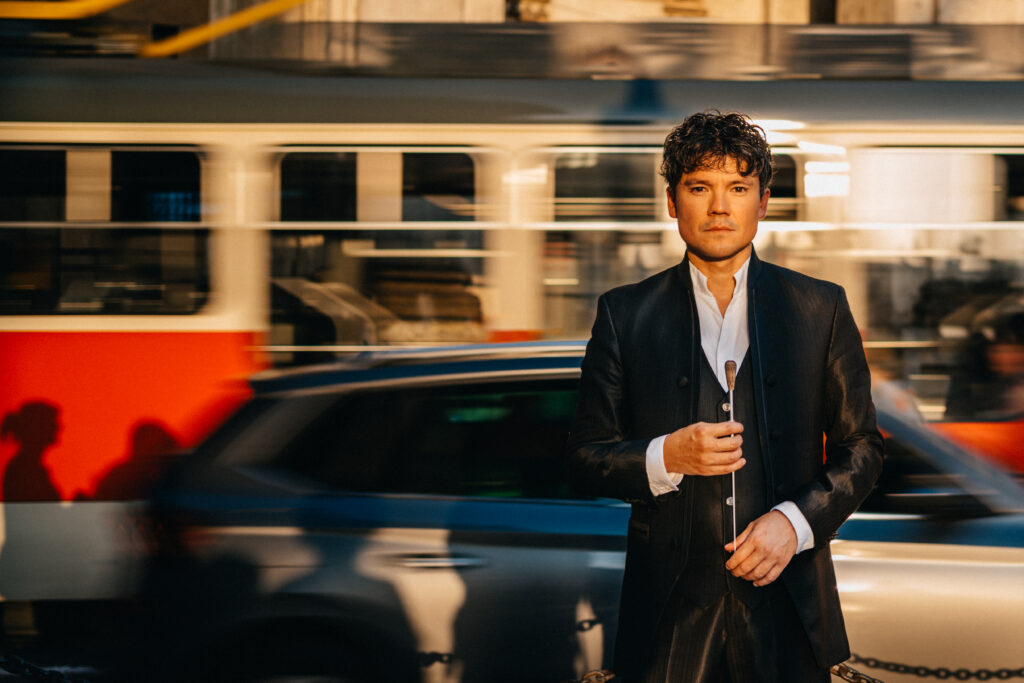
New Prague Radio Symphony chief conductor Elias Grandy (Photo courtesy of PRSO)
Elias Grandy is a charmer.
Oddly, the new chief conductor and artistic director of the Prague Radio Symphony Orchestra doesn’t come off that way in photographs, where he tends to look stern and young for his age (45). But in person he’s affable and engaging, with a touch of class. And thrilled to be joining the orchestra for its centenary season.
“I’m fortunate that my tenure starts now and I can be part of the celebration,” he says. “It’s a joy to pick up the torch and lead the orchestra into its next 100 years.”
Grandy grew up in Munich under the care of a German father and Japanese mother. Though neither of his parents are musicians, the family enjoyed singing together and it was expected that Elias would learn to play an instrument. He started cello lessons at the age of eight, and also plays piano. But his real inspiration came from going to orchestra concerts and operas.
“I got very passionately engaged with live music, spending a lot of my time and most of my pocket money on all kinds of performances,” he says. “I was lucky to hear an enormous amount of music at a high level. It made me dream of one day being a conductor myself.”
Grandy studied in Munich, Basel and Berlin, and launched himself into prominence with a second-place win at the Sir George Solti International Conductors’ Competition in 2015. He started his professional career as resident conductor at Staatstheater Darmstadt, and went on to spend eight seasons as music director of Theater and Orchester Heidelberg. Currently, he is chief conductor of the Sapporo Symphony in Japan. He’s led orchestra concerts on three continents and opera productions in Tokyo, Frankfurt and Dresden, as well as Minneapolis and Portland in the US.
Grandy’s first encounter with PRSO came in March last year, when he asked to step in as a substitute conductor. That can be a fraught situation, but he enjoyed it. “Of course there was pressure, but in that kind of situation, there are no expectations, which can be an advantage,” he says. In this case, there was an immediate connection.
“They are a wonderfully warm and emotional orchestra with a joy in making music and an openness to changing things, always looking to make them better,” he says. “This is personally rewarding for me, because I’m not there to recreate a certain way of playing or duplicate a recording. It’s more about being in the moment.”
To achieve that, Grandy likes to work on details. “When you start changing little details, you realize how much impact it can have,” he says. “My job as a conductor is to create an environment where we are able to pay the utmost attention to every detail, and once we’ve done that, be free to fly and just enjoy the beauty of the music.”
That’s the technical level. Grandy works just as hard on the emotional content of the music. “As a conductor, you study the music, you read the score and you develop a feeling,” he says. “That feeling is what you want to create for the audience. We can do that here because the level of musicianship is fantastic. There’s that connection between heart and mind – the players are highly trained, but never lose those feelings. That’s a special treat, and I’m very happy to be part of it now.”
Grandy is refreshingly humble when asked if he has a vision for PRSO, deferring to the job ahead. “I think what’s most important is working with what you have,” he says. “You pick up the orchestra at a certain point, and by working together regularly, you develop a relationship. This happens naturally. As we get to know each other, I’ll learn about the specific sounds that the orchestra has, and how to cultivate and support them.”
For all his experience, Central Europe is new territory for Grandy, and he’s fascinated by what he’s found so far. “The connections to places like Vienna and Berlin are amazing, and then you have the people who were born here, like Mahler and Korngold,” he says. “For me, the 20th century is particularly interesting, because in Germany it was cut off. Here you have histories reaching all the way back to Mozart. So there are many wonderful connections to discover or rediscover.”
Grandy did not have much input into PRSO programming for the coming season, though he says he’s glad to see Mahler and Strauss in the mix. Mostly he’s happy to support the season-long celebration. “We’re starting with the very first program the orchestra played 100 years ago, and we have all the leading Czech conductors coming to conduct this season,” he says. “I just feel honored to be part of it.”
The orchestra will offer a preview at the Dvořák’s Prague festival this week, with Debussy’s Prelude to the Afternoon of a Faun and Ravel’s Bolero bookending a Schulhoff symphony and the world premiere of a new concerto by Czech conductor and composer Jan Kučera. Grandy likes the mix and balance in the program. “If you consider Schulhoff a Czech composer, we’ll have Czech music in the middle and then different parts of the 20th century on both ends,” he says. “So you’ve got composers working with structure and color in completely different ways, which I think is going to be very interesting.”
And Grandy is already well aware of how much Czech music is part of the national identity. “Absolutely, this is an enormous music-loving culture,” he says. “It’s a great tradition, and I’m hoping to become part of it.”