Previously
Rudolfinum
September 6-12
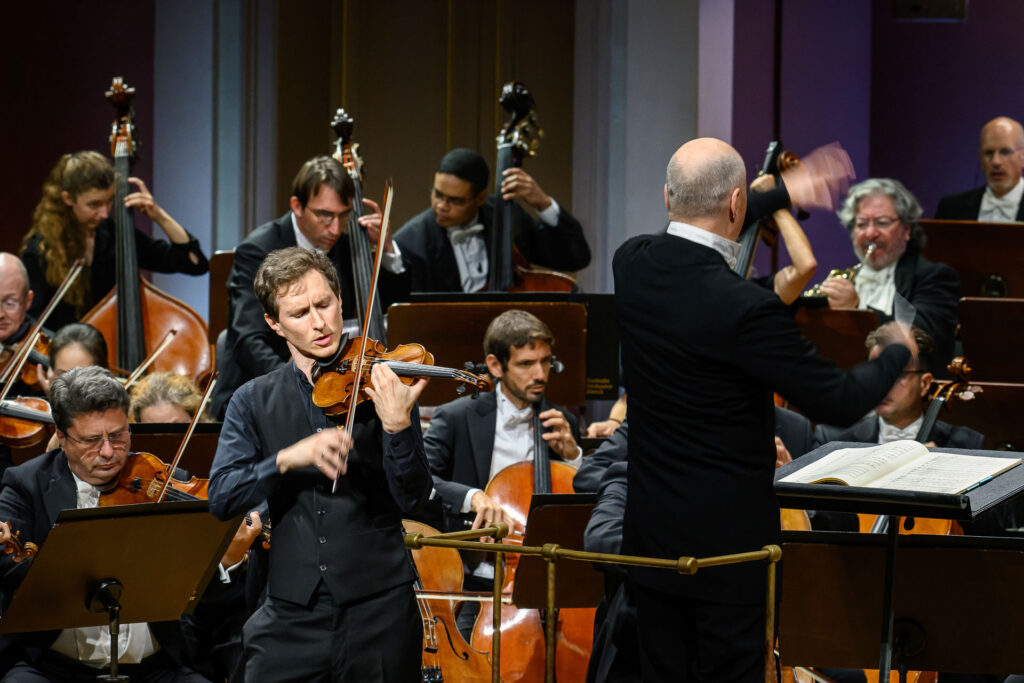
Soloist Josef Špaček with conductor Paavo Järvi (Photo by Petra Hajská)
Sunday: Filarmonica della Scala
It’s not uncommon for visiting orchestras used to performing in large halls to come to the Rudolfinum and blow the roof off the place. Or at least that’s how it seemed in the finale of this concert, Tchaikovsky’s Symphony No. 4, which opened with big blasts of brass and built to overwhelming cascades of sound that roared off the stage. The percussion could have been an army marching into Dvořák Hall. Still, there was no lack of technical expertise amid the din, particularly in the nearly all-pizzicato third movement.
Veteran conductor Riccardo Chailly showed why he is considered among the world’s finest, sculpting the sound to a fine polish, emphasizing clarity and depth. He rendered the opening piece, Rachmaninoff’s seldom-performed symphonic poem The Rock, in immersive detail, with a liquid flow that belied the title. Chailly’s backing for Rachmaninoff’s Piano Concerto No. 4 was lushly Romantic and left plenty of room for the soloist, Alexander Malofeev.
Just 24, Malofeev looks half his age but plays with a mature sensitivity and sophistication. His style in the concerto was deliberate, even heavy sometimes, perhaps to match the volume of the orchestra. A better taste of his talent came in his encore, Rachmaninoff’s Prelude in C-sharp minor, Op. 3. No. 2, in which he showed command and flair missing from the concerto.
Tuesday:Tonhalle-Orchestre Zürich
The program promised a night of tortured artists: Shostakovich’s Violin Concerto No. 1, hidden away for years under Soviet oppression, and Beethoven’s Symphony No. 7, written when the composer was seriously ill and dealing with encroaching deafness. Instead, conductor Paavo Järvi served up a convincingly understated version of the concerto, letting soloist Josef Špaček carry the emotional weight, and a boisterous reading of the symphony that verged on explosive at times. Fresh and unexpected, it made for an exhilarating evening.
Working without a score, Järvi opened the Beethoven symphony with a bang – literally – and bright colors, both of which remained in the forefront of his interpretation. A fast-moving tempo was reinforced by playing the piece through, with no more than a heartbeat between movements, leading to a racing finale. If his approach bordered on brash, it produced an exciting performance that garnered an enthusiastic response. (A longer review is available here.)
Thursday: Czech Philharmonic
Conductor Semyon Bychkov opened the evening in high spirits, setting a fast pace at peak volume for Dvořák’s Carnival overture. The big driving sound occasionally buried some of the musicality, in particular golden strings and whirling woodwinds that were exhilarating in the quieter passages. Hitting the percussion hard propelled the dance rhythms, with a frothy finish to the sound adding a euphoric touch.
Shifting gears, Bychkov served up a modern reading of Ravel’s Piano Concerto in G major – precise, finely detailed and richly expressive. He showed a deft hand with the intricacies of the sound effects and timing, crafting accompaniment that was brisk and colorful, captivating music in itself. Lim’s performance, alas, did not match the orchestra’s. His technical command was impressive, but his playing sounded uninspired, even plodding at times, especially in the solo opening of the second movement. Overall his sound was heavy, especially in contrast to the nimble work of the orchestra.
Only the first three movements of Smetana’s Má vlast were performed for the finale, but they were enough to show how the nationalist elements in the piece could be rendered with rigor in a vivid visual style that makes the music universally accessible. Crisp harps opened Vyšehrad, and throughout the entire movement Bychkov struck a fine balance between emotional yearning and disciplined playing. Vltava (aka The Moldau) sounded as it should – sparkling and flowing and occasionally choppy, like a boat ride, with colorful depictions of scenes onshore. Šárka brought the warrior maiden to life with martial rhythms and vibrant sounds of battle, ending in an explosive finish. (A longer review is available here.)
Saturday: Vienna Philharmonic
Hearing this orchestra is like getting your ears tuned. The sound is golden, the playing is at a virtuoso level and the performances consistently set a world standard. Russian conductor Tugan Sokhiev was on the podium for a bracing program of Dvořák’s Violin Concerto in A minor, featuring soloist Hilary Hahn, and a suite from Prokofiev’s Romeo and Juliet compiled by Sokhiev.
Hahn offered a sweet version of the concerto, in soft rounded tones with a touch of lyricism. Her style was so fluent that it was easy to forget how technically challenging the piece is, in particular the final movement, which requires considerable finesse. Some of the finer details of Hahn’s playing were lost in the wall of sound from the orchestra, which Sokhiev rendered with both power and elegance. But the overall effect was charming, an artful balance of expression and expertise.
The Prokofiev suite opened with clashing sounds and sweeping phrases, setting a cinemascope frame for a high-powered portrayal of nine scenes from the ballet. Composed in a symphonic style, it gave Sokhiev an opportunity to create fast-paced action and high drama, all pulled along with irresistible momentum. He showed an expert command of dynamics throughout, and a rhythmic flair in the two outright dances. Crisp percussion and glimmering strings gave the music a fresh feel, with a stormy finale providing a satisfying conclusion.