
Previously
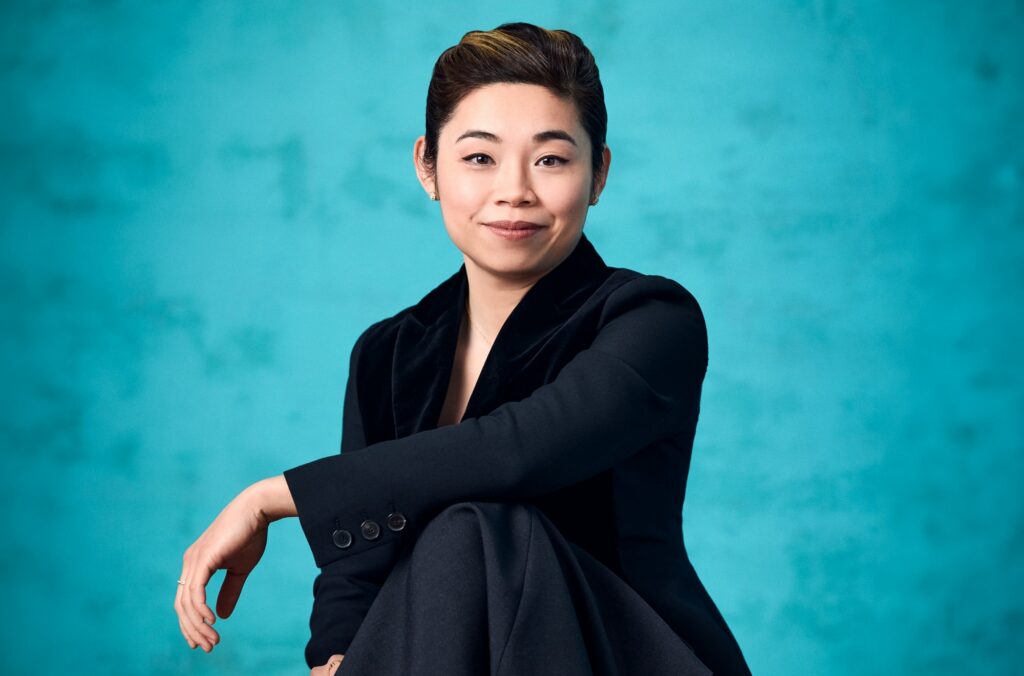
The Asian artist defies all the stereotypes (Photo courtesy of the San Francisco Symphony Orchestra)
Conductor Elim Chan has heard it all: “Oh my goodness, can we even see her?” “How about making the podium taller?” “Ha, ha, ha, is she nine years old?”
Her diminutive size is only one of the challenges that Chan has overcome on her way to becoming a classical star. She’s Asian, she’s a woman, she got started in music late – any one of which posed an almost insurmountable barrier until relatively recently. She has made her way on her talent and her determination and a performance history over the past 12 years that makes her an excellent choice to close out this year’s Dvořák’s Prague festival.
Chan will be in very good company. She’s leading the Czech Philharmonic in a program of Martinů, Dvořák, Prokofiev and Stravinsky, with one of the world’s great violinists, Gil Shaham, carrying the heavy solo load in Prokofiev’s Violin Concerto No. 2. Chan made her debut with the orchestra in November last year as a substitute for an ailing Semyon Bychkov, and recalled the experience with typical self-effacing humor.
“They were bowing towards me or doing a lot of these Asian customs, ultra-polite,” she told Bachtrack. “I said, ‘You don’t need to do this. I’m not Japanese. I’m just Elim!’”
(Chan only gave one interview for her Dvořák’s Prague appearance, to Seznam. The quotes in this story are culled from other interviews she has done.)
Born in Hong Kong, Chan, who will turn 40 next month, learned to play piano and sang in choral groups as a child. She did not plan a career in music. Instead, she went to Smith College in America to study psychology, preparing for a career in health care. But she had an enduring fascination with conducting. She happily admits now that her interest was first sparked by Mickey Mouse waving a magic wand in Fantasia. Subsequently seeing a female conductor, Yip Wing-sie, leading the Hong Kong Philharmonic, she decided there was no reason a woman couldn’t do that just as well as any man.
Still, it wasn’t until her second year at university that she had a musical epiphany. She had joined the school choir, and recognizing her talent, the director asked her to help out with conducting. One day she was rehearsing the “Dies Irae” from Verdi’s Requiem when it suddenly struck her: “It felt like a thunderbolt hit me on the head,” she said. “I heard a voice that was like, ‘Elim, this is it. This is it. You have to do this.”
Chan took up formal music studies at the University of Michigan, and like many great classical artists, was propelled to prominence with a competition win. She took first place at the Donatella Flick Conducting Competition in London in 2014, the first woman ever to do so. The prize was £15,000 and a one-year apprenticeship as assistant conductor with the London Symphony Orchestra. Valery Gergiev was principal conductor at the time, and was so impressed that he threw her into the fire, running rehearsals of all five Prokofiev piano concertos for BBC Proms concerts, and later having her lead his Mariinsky Orchestra on a tour of Mexico.
One way to chart Chan’s rise since is through the people she has been associated with – musical luminaries like Gustavo Dudamel, Simon Rattle, Bernard Haitink and pianist and collaborator Igor Levit, who describes her style as “this really wonderful mix of the highest expectations and yet the highest degree of generosity.” Another measure is the long list of orchestras she’s conducted, which includes many of the biggest names in Europe ( Munich Philharmonic, Sächsische Staatskapelle Dresden, Royal Concertgebouw) and most of the major orchestras in America (Cleveland, Chicago, Boston, Philadelphia, Los Angeles, New York).
She has also held a number of noteworthy positions, including five seasons as principal guest conductor of the Royal Scottish National Orchestra and another five as chief conductor of the Antwerp Symphony Orchestra. Earlier this year the San Francisco Symphony announced her appointment as chief conductor for six years starting with the 2027/28 season. One could point to any number of reasons for that choice – it certainly doesn’t hurt to have an Asian conductor in a market with a significant Asian population. But from the players’ standpoint, it’s mostly about her facility with the music and the orchestra.
“From Elim Chan’s first rehearsal with the San Francisco Symphony, it was clear that she is an extraordinary musician and an original interpreter with a distinct artistic voice,” principal second violinist Jessie Fellows said. “She brings passion, imagination and a deeply communicative approach that I find incredibly inspiring. Her vision and artistry feel especially aligned with San Francisco’s spirit of innovation, curiosity and possibility.”
Offstage, the situation in San Francisco has been fraught. Esa-Pekka Salonen stepped down from his position as music director last year after budget cuts severely curtailed his plans for the orchestra. And just two weeks ago, the musicians went on strike, citing a need for higher salaries in a pricey city. The dispute was quickly settled. And Chan’s job is about the music, not management. Still, it will be interesting to see whether she can bring a calming influence to troubled waters.
One thing is certain: Whatever else happens, Chan will not trade on her distaff status. She has always eschewed any kind of “first woman to…” recognition. In fact, despite the impressive inroads that female conductors have made in recent years, she doesn’t see any advantage in her situation.
“Times have changed and there are more opportunities today,” she told The Guardian. “At the same time, it has become more difficult, because the pressure is so high due to everything being so visible now. In some ways, it’s like a double-edged sword. Just one mistake and it’s, ‘Oh look, she’s not ready.’”
Chan deals with that the same way she has faced every challenge in her life – by forging her own path. “We’re in a time when women need to find their own way of leading, of being true to themselves,” she said. “Whether you wear a dress or pants, have short or long hair, authenticity – being honest and being who you are – is very powerful. Not all orchestras are ready to take that.”
Is the Czech Philharmonic? We’ll find out on Wednesday.