
Previously
Rudolfinum
October 13
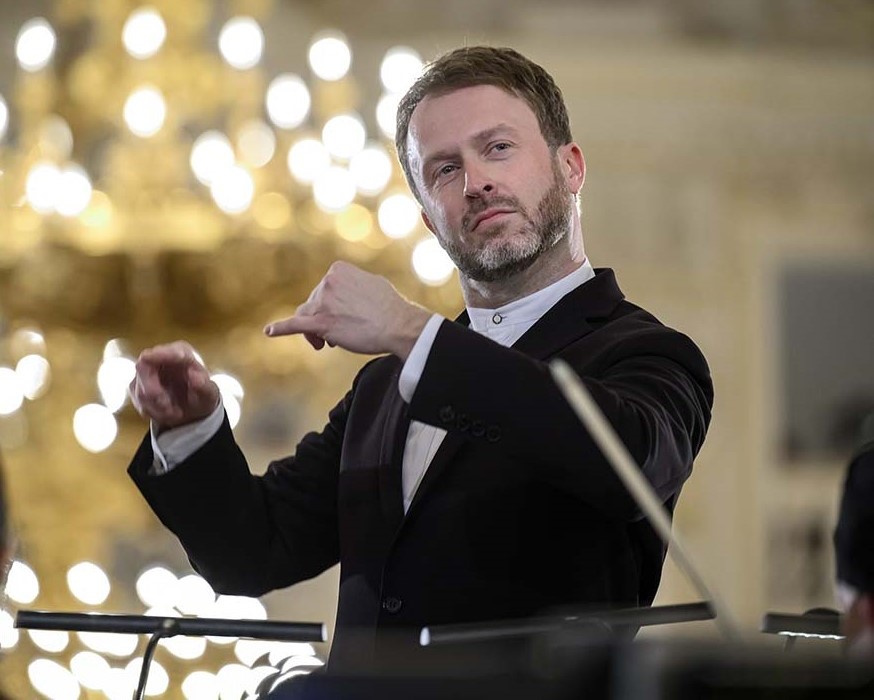
Choral maestro Lukáš Vasilek (Photo by Petra Hajská)
That’s “Let’s Sing!” in Italian, an invitation to join the Prague Philharmonic Choir in its opening concert of the season. The program comprises a single well-known piece: Carl Orff’s Carmina Burana. And the audience has been recruited to sing along.
The monumental cantata requires a huge cast, but even by the usual standards, PPC is taking an outsized approach. With the Prague Radio Symphony Orchestra providing the music, the choir will be joined by three vocal soloists (Veronika Rovná, Daniel Matoušek, Svatopluk Sem) and no less than eight additional choirs. They range from the mixed adult group Bohemiachor, which brings together singers from all over the country, to the Kajetán Children’s Choir, which won the grand prize at the Cracovia Cantans international choral competition in Krakow earlier this year.
For all that, the real stars of the show may be siting in the audience. PPC invited amateur singers to join in by applying for special seats and scores, and hundreds of people responded. Like the professionals, they have been divided into voice groups (soprano, alto, etc.) and will participate in the rehearsals.
It’s an audacious project that should rattle the rafters at the Rudolfinum. Principal conductor and artistic director Lukáš Vasilek took time out from his busy schedule a few days before the concert to talk about the rationale and preparations for the performance.
For your choir concerts, you normally program challenging pieces that aren’t heard very often – for example, Stravinsky’s Oedipus Rex, which you staged earlier this year. Why did you choose a popular work like Carmina Burana to open the new season?
The reason lies in the unique format of this concert. We were looking for a piece that would excite amateur choral singers enough to make them want to sing it along with us. And such a piece had to be very catchy and popular. That’s why we chose Orff’s cantata. I think it was a good move; there was a huge amount of interest.
Why did you decide to use so many choirs? And why those specific choirs?
We wanted to fill all the balconies at the Rudolfinum. Based on the number of seats, we worked out how many choirs and how many individual participants we would need. In most cases, we approached ensembles with whom we have done similar projects in the past. We had great experiences with them, I’m glad they’re with us again.
That’s a lot of singers! Where will you put them all, and do you have any concerns about everybody being able to see you?
According to our plan, the other choirs and amateur singers will fill all the balconies. The Prague Philharmonic Choir will be in the gallery above the stage, as usual. I don’t think there will be any problems connecting with everyone – the Rudolfinum isn’t that big. Moreover, for the joint singing, I’ve chosen only those sections that are relatively easy to coordinate.
Have you tried an audience singalong before, and if so, how did it work out?
Yes, two years ago we performed Dvořák’s Te Deum in a similar way, and within the past year we presented a special program exploring Dvořák’s time in the USA and his relationship with spirituals. On those occasions, working with amateur singers proved successful, it was a rewarding experience for everyone involved. The choirs were impeccably prepared and everything went very smoothly.
Did you get a good response to your invitation for audience members to join the choirs?
The places for individual participants sold out almost immediately. We’re delighted by this! It shows the great enthusiasm that amateur singers have for participating in such major events. A total of 400 of them will be singing with us.
How much of Carmina Burana will the audience members actually get to sing?
They will be singing eight selections with us; most of them are very well-known and popular. The Prague Philharmonic Choir will handle the rest.
This should be a memorable concert experience, for both the performers and the audience. What are your hopes for the performance?
We are looking forward to filling the entire Rudolfinum with a sound that will perfectly fit Orff’s composition. It will be a magnificent experience for the audience, which will be surrounded by singing on all sides.