Previously
Signal Space Gallery
November 2
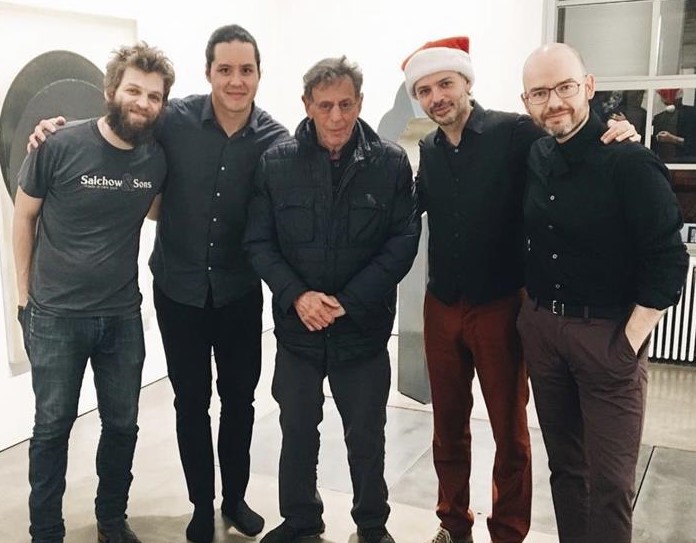
The Riders and the composer share a bit of Christmas cheer (Photo courtesy of Brooklyn Rider)
The American string quartet Brooklyn Rider has been on the cutting edge of contemporary music ever since it was founded in 2005. To celebrate its 20th anniversary, the group decided to offer a marathon program of all nine of Philip Glass’s string quartets, which normally take three evenings to play. After a number of well-received performances in the US, the quartet is bringing an abbreviated version of that project to open this year’s Prague Sounds festival on Monday night at the Signal Space gallery.
This is not the quartet’s first appearance at the festival. They performed in 2010 (when it was still Strings of Autumn) with Iranian kamancheh virtuoso Kayhan Kalhor, who plays with Brooklyn Rider violinist Colin Jacobsen in Yo-Yo Ma’s Silk Road Ensemble. Jacobsen is also a founding member of the New York chamber orchestra The Knights. He generously agreed to take some time out of his busy schedule to talk about Brooklyn Rider’s Philip Glass project and the group’s return to Prague.
Prague Culture: Your ongoing project to present the complete string quartets of Philip Glass marks the first-ever retrospective of his work in that genre. What prompted you to embark on such an ambitious effort?
Colin Jacobsen: Philip Glass’s string quartets have been with us ever since our first Brooklyn Rider concert, in which we paired his third string quartet, Mishima, with a Mozart quartet. Initially drawn by the vivid interior world that Glass is able to paint with beautifully minimal musical resources, we realized pretty quickly that his music was sort of a Rosetta Stone for string quartet playing. As in the music of Bach, the architecture is quite clear, as well as the emotional effect. But there’s also a sense that by playing their music, you are constantly learning something along the way.
With Glass, there are lessons for a string quartet around the blend of sound, transparency of texture, of resonance, of rhythmic feel, of learning a sense of shared patience and much more. But ultimately it is music that lives best in front of an audience, as Glass leaves much room for listeners to have a personal journey while in a shared space with the resonance of this music. Over the years, we’ve recorded all of his string quartets, and for our 20th anniversary we thought we’d offer this unique project of performing all of them live.
PC: Can you talk a bit about your longstanding collaboration with Philip Glass? What has it been like to work with him, and are there any scenes or memories from your sessions with him that have stayed with you?
CJ: While his music has been with us all these years, we actually haven’t worked directly with Philip that many times. Some composers are controlling about every note they write and how they want to hear it – and they often want to hear it before you perform their music publicly! Glass falls on the other side of the spectrum: He writes the music, puts it out into the world, and lets it learn to walk and breathe on its own for the most part.
That said, several memories do stand out. When we were playing and recording the sixth and seventh quartets, which had just recently been written, for his Orange Mountain Records label, we got to go to his home in the East Village in New York. It was wonderful just being in the atmosphere of the space where he’s written such an incredible volume of music. And then we were surprised to see him actively changing things like tempo markings, articulations and even notes/voicings in response to hearing the music live.
I also fondly remember performing at a gallery downtown that has long been a home for his music with Philip present. And when we embarked on our project of the complete quartets at the [Metropolitan Museum of Art] Cloisters just a year and a half ago, he came to the opening in the beautiful, intimate chapel there.
PC: Among the performances you’ve given of the Glass program to date, one of the most intriguing was in Los Angeles amid the wildfires in January 2025. Was that a response to the disaster, or a concert that was planned before the fires broke out? And what was it like playing in that charged atmosphere?
CJ: That concert had been planned already, and indeed there was a heavy atmosphere in the room. Once again, I think of Glass’s music in relation to the music of Bach. Both are able to bring comfort and understanding to the listener who might be in emotionally difficult circumstances. We certainly felt a lot of gratitude in the room for the sonic space that Glass gave people to process what they were going through.
PC: The program that you played in Los Angeles is identical to the one you will be performing in Prague. Normally, it takes three nights to play all nine quartets. How did you decide on the six that you play in a one-night program?
CJ: Indeed, it does take three performances to play all of his quartets. In deciding on these particular pieces, we chose those that we feel most connected to, representing work from the ’80s to the last decade. In this mix you have the supreme architecture of the second quartet, Company; the epic dramatic arc of his fifth quartet; the singular beauty of the fourth quartet, in particular in its celestially floating second movement; and the transformation that never fails to give me goosebumps at the end of his third quartet, Mishima.
PC: It’s been 16 years since you were at the festival with Kayhan Kalhor, and you’ve obviously played a lot of concerts since. Still, if you have any memories or impressions from that performance, it would be very interesting to hear them. And how are you feeling about coming back to Prague?
CJ: I remember the beauty of the city, the warmth of the people and the open ears and intense listening of the audience. It allowed for a spiritually enriching experience in the concert with Kayhan, and I imagine that people who enjoyed that concert will appreciate Glass’s music as well.
There’s a lot more happening at Prague Sounds this year. A complete schedule is available here.