
Previously
National Theater
October 15
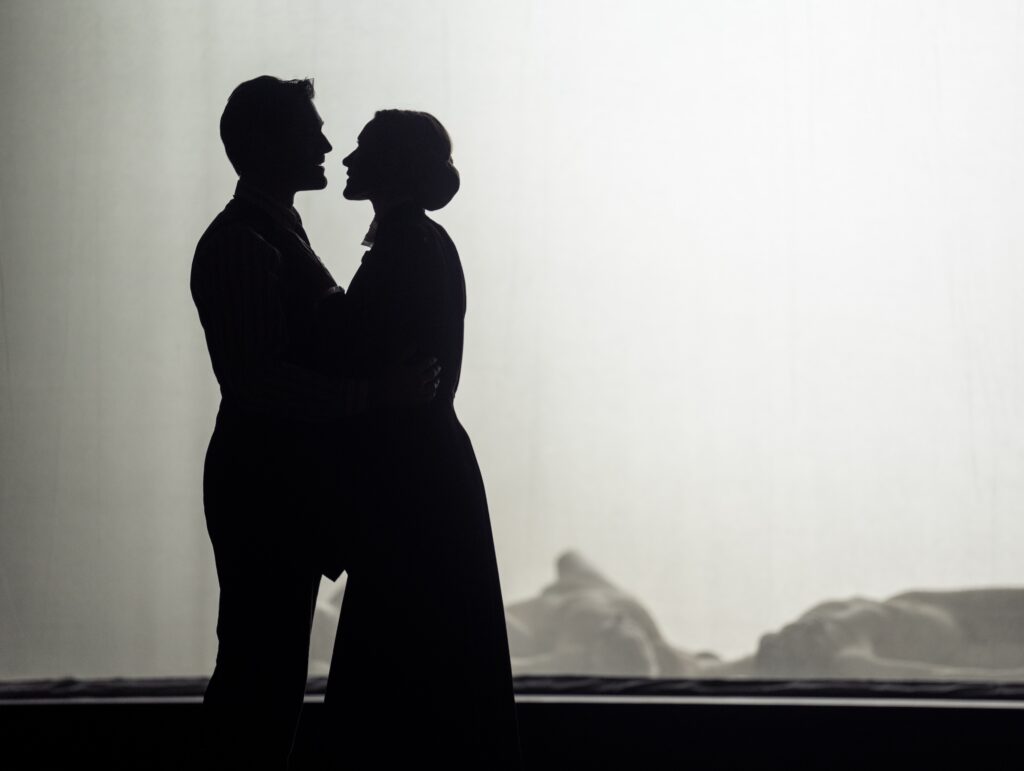
An unnerving juxtaposition of love and death (Photo by Petr Neubert)
If draining all the passion out of a love story can be considered an achievement, then give director Christoph Loy a gold star. No, make that five gold stars, one for every act in Pelléas et Mélisande. In a new production at the National Theater, Loy reduces the characters in Debussy’s only opera to walking metaphors, draining all the life out of what should be an emotionally charged story. With a running time of nearly four hours, it makes for a long and disappointing evening.
Pelléas is a romantic tragedy in a fairy tale setting. Lost in the forest, Prince Golaud encounters a mysterious, distraught woman who will tell him only that her name is Mélisande. Enchanted, he marries her and takes her to his grandfather King Arkel’s castle, where she meets his stepbrother Pelléas, who also falls in love with her. A series of trysts inevitably leads to Golaud discovering their affair and taking bloody revenge on Pelléas. Mélisande fares badly with a pregnancy, leaving Golaud bereft in the final scene, wracked with guilt and pain.
Loy approached the story by going back to the source material, an eponymous 1893 play by Belgian poet and playwright Maurice Maeterlinck. He was an ardent proponent of Symbolism, a late 19th-century artistic and philosophical movement that rejected realism, preferring symbols and metaphors as proper modes of expression. As Maeterlinck interpreted this for the theater, that meant spare dialogue and minimalist acting (he once suggested that marionettes were better-suited to perform his plays).
With Pelléas, Maeterlinck recast a classic tale of love and betrayal into an allegory of existential despair. Plot, character, even rationality take a back seat to a depiction of merciless fate closing in on bewildered, hapless humans for whom death offers the only escape. The mood is ominous, the situations surreal, logic a false construct – elements that Loy captures effectively.
How these play out for 21st-century sensibilities is another matter. Despite contemporary costumes and sets in the National Theater production, there’s no one and nothing to relate to onstage, just misguided figures blind to their circumstances, fumbling their way to their doom. Maeterlinck dubbed his preferred style of acting “static theater,” which is a good way to describe the movement (or lack thereof) in Loy’s treatment. Coupled with bare-bones sets, his reductive approach gives this version of Pelléas a sterile feel, an impression reinforced by deliberately wooden acting. And while incongruities in updated productions are not uncommon, this one serves up a steady flow of absurd disconnects – “Where’s my sword?” Golaud asks at one point while looking for his rifle – that border on comic distraction, almost daring viewers to keep a grip on credibility.
Loy has a knack for creating powerful visual moments. Physically framing Mélisande between Golaud and Pelléas in the first act telegraphs the brothers’ competing affections, and Pelléas and Mélisande embracing in the second act with supine bodies in the background offers a powerful juxtaposition of love and death. But more often the staging is leaden, or just confusing. Loy likes to keep his characters onstage, so Golaud is in the room while a letter is read to King Arkel saying that he’s at sea. Slo-mo movements deaden a piece already singularly lacking in action. And there are long musical interludes where absolutely nothing happens.
On the plus side, less happening onstage means more opportunity to focus on the music, which is sublime. In insightful program notes, visiting conductor Patrick Fournillier describes the role of the orchestra as neither accompanist nor commentator, but rather an independent voice, which he brought to life eloquently. Under his baton, the music set mood and tone, extended vocal lines, offered occasional counterpoint, built tension – and most importantly, revealed characters’ inner thoughts and feelings. Fournillier also made the most of the occasional pauses in the score, letting them serve as silent statements. Working well outside of its usual repertoire, the National Theater Orchestra did a superb job playing softly yet with colorful conviction.
Arnheiður Eiríksdóttir was in good voice as Mélisande, tender and vulnerable. She is also an accomplished actress who unfortunately was limited to nothing but cowering in this role. David Oller (Pelléas) and Pavol Kubáň (Golaud) both turned in strong singing performances, though neither showed much in their limited acting opportunities, other than Kubáň’s exasperated rage over his brother and wife’s trysts. Anders Lorentzson made a serviceable Arkel, and young Joshua Alvarez won the audience’s heart as Yniold, the beleaguered son of jealous Golaud.
On balance, there is certainly something to be said for preserving the original form of a work like Pelléas et Mélisande, bringing a historical dimension to the performance. But asking a modern audience to sit through a nearly four-hour production that doesn’t offer any real drama until the final act is a stretch. Symbols are a language of their own that apparently doesn’t always resonate across eras. Or at the very least, needs some translation.