Previously
Rudolfinum
November 19
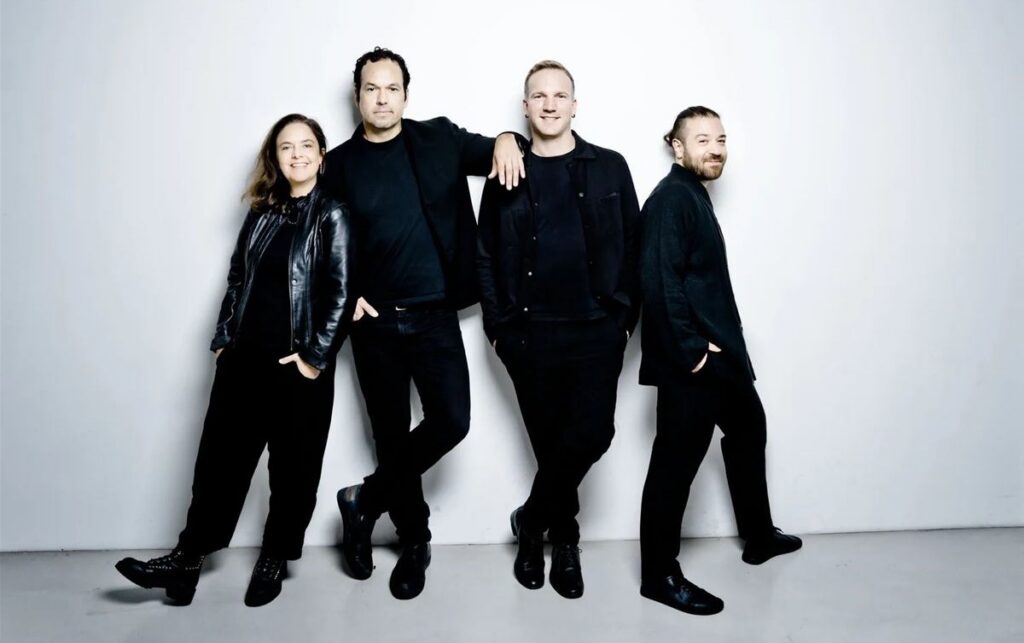
Mivos Quartet, from left: Olivia De Patro, Victor Lowrie Tafoya, William Overcash, Nathan Watts. (Photo by Marco Borggreve)
American composer Steve Reich’s 90th birthday has been occasion for commemorative concerts worldwide this year, and few offer a program as ambitious as the one Prague Sounds is staging at the Rudolfinum this week. Prague’s own Agon Orchestra will be performing Reich’s raucous City Life, and an innovative group of German and Canadian keyboard players are coming together for his Six Pianos Project.
The New York-based Mivos Quartet will open the concert with Different Trains, which may be the most intriguing piece on the program. Composed in 1988 for the Kronos Quartet, it was inspired by cross-country train trips that Reich took as a child. Many years later he reflected on the fact that if it had been a few years earlier, and he was in Germany rather than America, as a Jew he would likely have been on one of the trains bound for an extermination camp. To confront the unthinkable, Reich decided on a groundbreaking approach that uses spoken word as a basis for the music. Specifically, he interviewed a number of people, ranging from an old Pullman porter to Holocaust survivors, and used excerpts from those conversations, building off their cadences. He also included sound effects like train whistles and sirens. The music itself is in four layers, three of which must be pre-recorded. So in performance, the live quartet is playing along with five tracks of tape recordings.
“When bits of Different Trains began to arrive in the mail, I knew immediately that something special was developing,” Kronos Quartet founder and violinist David Harrington said. “Everything about Different Trains – its boldness, its subject matter, its sound requirements – pushed Kronos and our music in many new directions.”
Different Trains came back into prominence in 2023, when the Mivos Quartet released a CD of Reich’s three string quartets. Taking advantage of advances in recording technology, the group offered a sharper, cleaner version of the piece. Below, Mivos viola player Victor Lowrie Tafoya talks about how the project came together, collaborating with Reich and what the audience can expect when his ensemble reprises the piece at the Rudolfinum.
Prague Culture: How did the project to record all three of Steve Reich’s string quartets come about?
Victor Lowrie Tafoya: I believe it was after a concert at the Jewish Museum in New York in 2015 that Steve first approached us and made the comment that we should record the pieces ourselves. We thought it was a great and completely unrealistic idea, and while flattered, didn’t give it much thought afterward. When we performed his music at Symphony Space in New York in the spring of 2017, afterward Steve came up to us again stating that we should really record these pieces. By that time, the backing vocal tracks had been remastered. So we thought, well, if he insists and thinks its a good idea, we should do it! That began the six-year journey of making the album that would eventually come out on Deutsche Grammophon in 2023.
PC: How much did you collaborate with Reich in making the recording?
VLT: We rehearsed with him a couple of times in New York and then in Los Angeles before beginning the recording process, working primarily on balance and articulation. He is very direct and clear in his musical intentions, and working with him was delightful. It meant a lot for him to trust us with this project, and we took our charge very seriously.
PC: Did you change very much from the original Kronos Quartet recording of Different Trains?
VLT: Different Trains is built from the recorded vocal tracks and train sounds that Reich compiled – their rhythm and tonality form the bedrock of the musical content. While these elements remain unchanged in terms of content, they had been cleaned up and remastered by the time we began our new recording project. What is new in our recording of Different Trains is that we re-recorded all the backing tracks from scratch. In other performances of the work, a live quartet was performing with the original Kronos Quartet backing tracks. We went back and built it all again from the ground up, so what you are hearing is all new Mivos Quartet tracks.
PC: Almost all the reviews of your CD talk about how tight the fit is between the voices and the instruments on Different Trains. How were you able to achieve that?
VLT: The rhythm of the voices in Different Trains is the striking element of the music. It is an incredible sonic journey, and over the course of many performances we came to live in the rhythmic and harmonic world that Reich creates so effectively in the piece. While the score is very clear, we pick up on subtleties of the text as much as possible, adding detailed amounts of vibrato to certain loops, accentuating consonants, placing minute dynamic swells in places. The music, in spite of being so deliberately composed, still comes to life in live performance.
PC: Different Trains has been described as everything from “a documentary in music form” to “a breakthrough in modern music.” How would you characterize the piece?
VLT: It is truly a modern masterpiece of the string quartet repertoire. Innovative as it was for using vocal rhythms as a composition foundation, it is much more than a modern innovation. The form of the work, the dramatic arc, the use of modal and tonal harmonic movement, and the poignancy of the subject matter make it a uniquely beautiful artistic achievement for the ages.
PC: How do you approach the piece when you perform it?
VLT: All great music is best when experienced live. Music is a living art form in this way, meant to be an experience had in real time rather than merely a product to be consumed. We strive to make every performance of every piece a moving, unique experience for each audience. And with a piece of this quality, we strive constantly to bring our very best to the stage. We want the audience to feel the simultaneous sensations of pathos and hopefulness embedded in the work itself. So our approach is to try to be consumed in the present musical moment, to make the performance an ecstatic experience for us and for the audience. This is achieved by maximum focus and maximum emotional openness.
PC: You were at the Prague Sounds festival in 2021, when it was still Strings of Autumn. What was that experience like for you, and how are you feeling about coming back to Prague and the festival?
VLT: The last time we were in Prague, we performed NGH WHT with music by Thomas Kessler and lyrics by Saul Williams, with Saul performing with us. That was another extreme combination of text and music put together to make something even greater than the sum of its parts. It was such a fun show! The whole evening was fantastic and inspiring. We are very grateful and excited to come back to Prague for this performance.
You can watch an interesting short documentary about Different Trains here.
More details about the concert and tickets are available here.