Previously
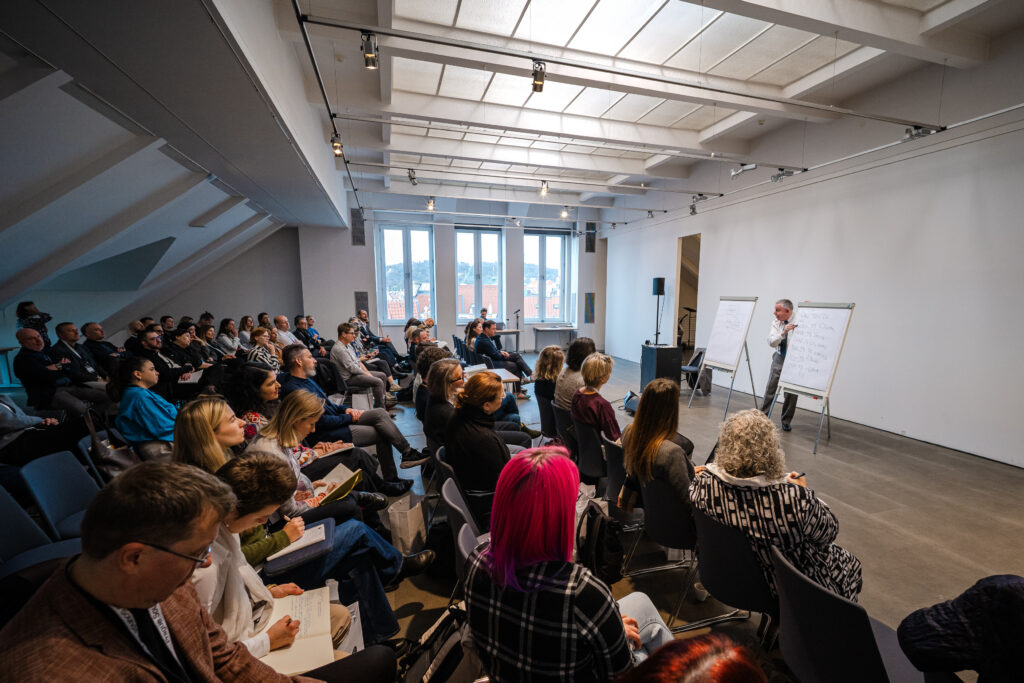
Kaiser leading the workshop at Old Town Hall (Photo by Jan Kantor)
If you ask an arts manager in Prague what’s being planned for next season, the typical response is a shrug and the admission, “It depends on what the Culture Ministry gives us.” And Prague is hardly unique in that respect. Throughout Europe, arts organizations are heavily dependent on goverment funding, a fickle source that can shift quickly in the political winds. Or vanish entirely.
So it’s no surprise that a workshop given by American arts guru Michael Kaiser in Prague last week sold out almost immediately after it was announced. Some 80 people from organizations like the DOX Center for Contemporary Art, Berg Orchestra, Blues Alive and JazzFestBrno gathered at Old Town Hall on Friday to learn how to build and sustain a viable arts organization without depending on government largesse.
Kaiser, 73, is uniquely positioned to give this advice. He is an administrator, consultant and turnaround artist who has saved or stabilized four major arts organizations – the Kansas City Ballet, Alvin Ailey American Dance Theater, American Ballet Theatre and the Royal Opera House in London. He may be best-known for the 13 years he spent running the Kennedy Center in Washington, DC, where he expanded programming, developed a number of education initiatives and built a base of 40,000 donors that helped raise the institution’s annual operating budget from $23 million to $83 million.
Along the way, Kaiser developed a system that he calls The Cycle for successful arts management. Over the past 30 years, he has traveled the globe explaining the system to eager arts advocates. He first came to Prague in 2008, and has made several visits since, though arguably his greatest impact here has come from the fellowship program that he ran at the Kennedy Center, where aspiring administrators spent a year learning the system firsthand. A number of alumni are now key figures in the Prague arts scene, a group that includes Prague Sounds Founder and Director Marek Vrabek, Berg Orchestra Managing Director Eva Kesslová, Kateřina Koutná at Prague Spring and Martin Pechanec at the Czech Philharmonic.
Kaiser ran a busy schedule in Prague that included a reunion on Saturday with 30 former fellows coming from six continents. The day before the workshop, he generously took time to talk about the work he’s done and the lessons he’s learned.
Prague Culture: Your first came to Prague in 2008 to talk about arts funding. What was your message then?
Michael Kaiser: From the beginning, I said that you have to learn how to do private fundraising, because you can’t count on the government forever. I’m not arguing that state funding is bad; I’m just saying that you have to realistic. You can fight and lobby and argue for government funds, but then you have to live in the real world, where you’re going to face cuts. If you’re going to protect your organization, you have to find money elsewhere.
I like to use the example of the Budapest Festival Orchestra. Even under [former Prime Minister Viktor] Orbán, when it was very challenging to be an arts organization, they got along, because Iván Fischer, who runs the orchestra, has always had outside fundraising as a source of support. That doesn’t mean government money isn’t important. But it means he was protected.
PC: How was that message received here?
MK: Not very well at first, until I pointed out that the National Theater was built completely with contributions. So while that may seem different now, it’s not new. [Editor’s note: Just two months after the National Theater opened in Prague in 1881, most of the building was destroyed by a fire. A nationwide fundraising effort collected enough money to have it rebuilt.]
PC: This time, there’s intense interest in your workshop.
MK: Because people are scared. And when they’re scared, they’re hoping there’s a magic answer. But there isn’t a magic answer. What you need to do is build a group of people who care about your organization, and get them more and more engaged. Not just corporate donors who are at arm’s length, but people who really care about your work, and are ready to help you when there’s an emergency.
PC: Have you seen improvement here?
MK: Oh absolutely, there’s been a lot of improvement. I think that Prague Sounds has done a fantastic job of building a donor base. And when I looked at the list of people coming to the workshop, I noticed that several are in fundraising. Back in 2008 it was like, ‘What’s that? That’s a profession?’ People couldn’t believe it.
PC: What have your experiences been like in other places in Europe?
MK: When I was in London, people thought I was rude. It was 1998, and the Royal Opera House was in a disastrous situation. They didn’t have enough money to finish a renovation, and they weren’t going to get operating funds from the government, which was threatening to shut it down and turn it into a receiving house. We managed to raise $100 million in 18 months. But in the press I was always called ‘Michael Kaiser the crass American,’ because I found enormous money, which we needed.
PC: What needs or gaps do you see in Prague right now?
MK: Three things:
First, great art is a requirement for any of this to work. I’m not saying there isn’t great art here, I’m just saying that’s not negotiable. The work has to be engaging and surprising and rich and exciting, and it should always have an element of wonder to it. If you want people to love and support you, great programming is the most important thing.
The second thing is what I call institutional marketing. We spend a lot of time doing the kind of marketing that sells tickets to a concert – email blasts, social media, posters – and rightfully so. But that’s only half the marketing challenge. You also want people to feel that you’re a really cool organization that they want to be involved with somehow. There are different tools and techniques for doing that. For example, Marek had public television at Prague Sounds this week, broadcasting four of the performances. That’s institutional marketing – getting people to say, ‘Wow, they’re on TV, they must be important.’
The third thing is the ability to make people feel welcome and at home within your organization. Traditionally, cultural organizations like to keep the audience at arm’s length – you come to the concert, you experience it, you like it, and you go home. What’s missing is the human element that makes people feel this is a place they want to keep coming back to, and people they want to be involved with.
I used to stand out on the steps before every performance that I managed, greeting the audience and talking to them. You start to see people repeatedly, and get to know them, and with some I’d share a piece of news that no one knows, like guess who’s coming next year. If you make people feel that they belong, they’re happy to support your work, because they feel that it’s theirs, too.
PC: That personal touch makes a difference?
MK: A huge difference! I remember birthdays, and if I know someone is ill, I call them up and ask how they’re doing, show them that I care. Which I do, it’s not phony. But it’s also a discipline to do that on an ongoing, repeated basis.
By the time I left the Kennedy Center, we had 40,000 people giving us money. I would be lying if I said that I knew them all personally. But I knew a lot of them, and they knew me, because I would be out there. They felt at home.
PC: And now the Kennedy Center is shut down.
MK: Well, it’s not the worst thing happening in America. But it’s a terrible thing to happen to an institution that was thriving, and now basically doesn’t exist. It’s just a huge, empty building.
PC: You devoted a lot of your life to the Kennedy Center. How are you feeling about what’s happened?
MK: I think it’s horrible. I mostly feel bad for the people who don’t get to enjoy performances, including myself, I live in Washington. And I feel particularly bad for the 10 million children across America who every year we educated in a serious way.
PC: Did you have to deal with political interference very much when you were there?
MK: Only in very minor ways. We fashioned ourselves as bipartisan, and everyone respected that. We always had 14 members of Congress on our board, roughly split between the two parties, and everyone knew that we didn’t talk politics. If someone, a board member or someone else, started to talk politics, we would say no, we don’t do that here. We’re doing work that we think is important for all Americans. Leave your politics at the door.
No one in Washington knows my politics, because I don’t discuss them. I have amazingly good relationships with people who are Republican leaders in Washington, and great relationships with people who are Democratic leaders in Washington, and the Supreme Court justices – all kinds of great individuals, on both sides. And they don’t know what my politics are, because I don’t talk about them.
PC: Can the Kennedy Center come back?
MK: In a couple years, hopefully we can get back in there and build it back up, but that will not be easy. It’s not like flipping a switch. There’s no staff, there’s no money left. So you have to not just find the money, which I think can be done, but you have to hire and train an entire staff. Who do you hire first, what kind of programming can you do quickest, how much money do you need to do this versus that – there are a lot of pieces to it, and it’s going to be a very, very difficult job.
I have drafted a plan for rebuilding the Kennedy Center. I have no standing to do that, and nobody asked me to do it. But I did it anyway, because my feeling is that one day we will be allowed back in, and the question will be, what do we do now? So I have a plan for that.
PC: Your main message at the workshop tomorrow?
MK: It’s mostly about The Cycle, but with that human element. How do you build a family of people for your organization who love you so much that they want to see you succeed? They might buy tickets, they might be board members, they might be volunteers, they might be donors. But what we need to do as arts organizations is build a family of supporters so that we’re not out there alone.
Michael Kaiser’s appearance was co-sponsored by Prague Sounds and the Czech Association of Festivals. More on Kaiser’s background and current work is available here.