
Previously
DOX
November 12
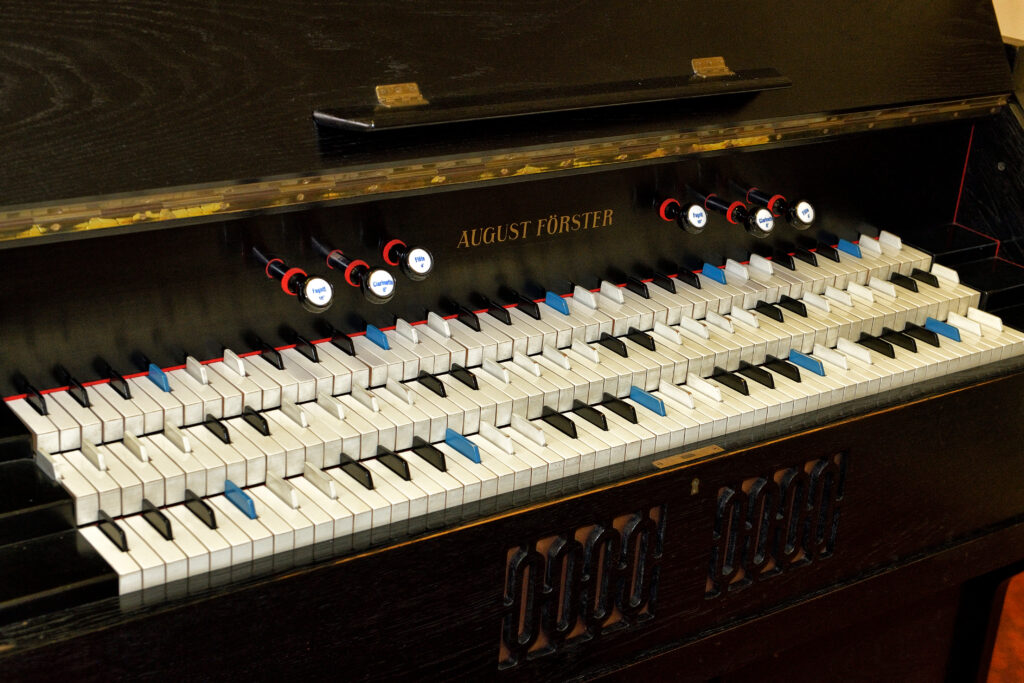
If it looks complicated to play, that’s because it is.
In the summer of 2018, the organizers of New Opera Days Ostrava (NODO) had a problem. They wanted to stage Thy Kingdom Come, an opera composed in the early 1940s by Alois Hába, a Czech pioneer of microtonal music. But the instrumentation called for a sixth-tone harmonium, and the only one in existence was in the Czech Museum of Music in Prague. And no one knew how to play it.
So they called Miroslav Beinhauer, a pianist based in Ostrava, and asked if he would be willing to give it a try. Being the kind of musician who likes a challenge, he agreed. And after sitting down at the instrument, wondered where to start. “It was so complicated just to understand,” he says. “It has nothing to do with a normal piano at all. But somehow I managed.”
Beinhauer not only managed to learn the instrument, but breathed new life into it with a series of performances that have started a revival. New pieces have been written for sixth-tone harmonium, and last week a brand-new replica of Hába’s invention was unveiled at the National Museum. On Thursday this week, modern music fans will have an opportunity to see Beinhauer play it at DOX, with the Ostravská banda orchestra and tenor Vojtěch Semerád accompanying him in a program that includes three world premieres.
One look at a sixth-tone harmonium would give anyone pause. It has three keyboards, six stops and two pedals that have to be pumped almost continuously to play Hába’s pieces. The arrangement of the keys, which come in three colors, is highly irregular. On a standard piano keyboard, an octave is divided into 12 sequential tones. On the harmonium, it is divided into 36 tones, which are not arranged sequentially; the player may have to jump keyboards to get from one whole tone to the next. Moreover, the functions are reversed – the small black and blue keys, rather than the large white ones, are the whole tones.
Does all this make it a difficult instrument to play? “Extremely!” says Beinhauer. “That’s probably why no one tried to play it for such a long time.”
Beinhauer relocated to Prague to take on the challenge, spending nine hours a day at the Music Museum learning how to play the instrument. He found himself on display along with the harmonium, an added complication until he was able to tune out the passing crowds and focus on his work. After several weeks, he still didn’t feel completely ready for Thy Kingdom Come. But the performance went well, inspiring him to learn the only other piece Hába wrote for the instrument, Six Compositions for Sixth-Tone Harmonium, Op. 37.
“I thought, if I don’t do it, no one else will,” Beinhauer says. It became more than a personal pursuit after he posted a video of himself playing Six Compositions on YouTube. “I got calls and e-mails from all over the world, from composers and musicians and journalists wanting to know more,” he says. “One composer even came from America to look at the instrument.”
The surge of interest triggered a series of performances in the Czech Republic and neighboring countries like Germany, Austria and Poland, and inspired a number of composers to write new works for the instrument. Five new solo works for sixth-tone harmonium were premiered at the National Theater event last week. This week’s program at DOX is offering new pieces by, among others, Klaus Lang (Austria), Miya Masaoka (US) and Martin Smolka (Czech Republic).
But transporting a delicate historical instrument is complicated, requiring several months of advance paperwork if the instrument is leaving the country. So the Czech Ministry of Culture agreed to fund the construction of a replica that could be put into everyday use. August Förster, the company that built the original, no longer had the expertise to do it, so the project was entrusted to Prague-based organ builder and restorer Martin Poláček. Finished just several months ago, his instrument is the one that Beinhauer will play at DOX.
To untrained ears – which is to say, to most of us – a sixth-tone harmonium can sound sour, like a regular harmonium being tortured. But Hába’s inspiration came from natural sources. “Even my neighbor’s dog Hector is not confined to the Western European tonal system,” he once said, though what actually fascinated him was vykrúcať, the tendency of Moravian folksingers to add small tonal inflections to their vocals. After discovering the same practice in other cultures, he formalized the technique in music that he started composing in the 1920s. The use of microtones was revolutionary at the time, but after World War II became the foundation for a fresh genre of contemporary music by a new generation of composers.
And as a player, Beinhauer has found new artistic possibilities in the sixth-tone harmonium’s expanded tonal range. “It’s more complicated to play, but it gives you more freedom,” he says.
Despite all the work he’s put into it, Beinhauer readily admits that microtone music has limited appeal. “It’s not for everyone, it can sound really crazy,” he says. “But it’s great for people who like to explore sounds.” He has also been pleasantly surprised by the number of people who approach him after concerts with questions and a desire to see the instrument up close. At a concert in Slovakia last month, they kept him onstage for 45 minutes after the performance.
Not all of them like what they’ve heard. But as Beinhauer says, “For sure I’ve got their attention.”
You can see Miroslav Beinhauer play Six Compositions for Sixth-Tone Harmonium here.
Program details and tickets to the DOX concert are available here.