
Previously
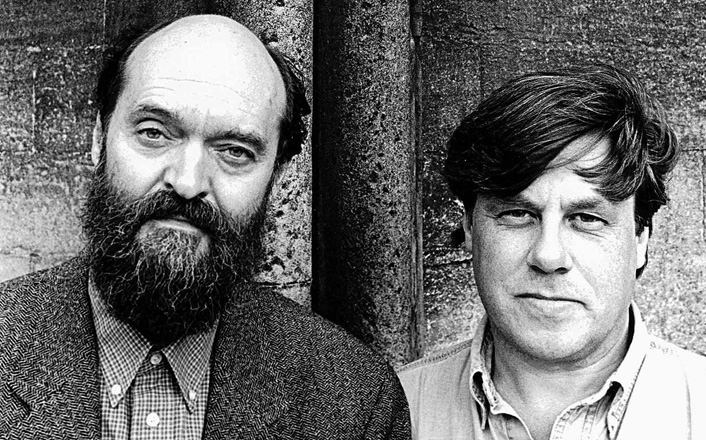
Paul Hillier, right, with Arvo Pärt in the late ’90s (Photo by Michael Putland)
British conductor and singer Paul Hillier has been a major force in choral music since 1974, when he co-founded the Hilliard Ensemble. Among his many accomplishments since then, the most enduring has been Theatre of Voices, a chamber group of singers that he founded in 1990. Now recognized as one of the world’s leading vocal ensembles, it has worked extensively with contemporary composers like Arvo Pärt, Kaija Saariaho and John Luther Adams. And it has a notable history with the Prague Sounds festival, performing David Lang’s Little Match Girl Passion in 2015 and Terry Riley’s In C in 2018, with the composers in attendance on both occasions. A late-night performance of Karlheinz Stockhausen’s Stimmung in 2015 also left a lasting impression, for reasons noted below.
Theatre of Voices is returning to the festival this year with Czech premieres of two recent works by American composers – Michael Gordon’s A Western (2019) and Julia Wolfe’s Italian Lesson (2025). The former is a nostalgic riff on a classic American cowboy movie, High Noon, complete with a commercial break, while the latter is a poem by Cynthia Zarin set to music that employs props like rustling dry leaves to add sound effects. Hillier, still active and voluble at the age of 77, graciously agreed to answer a few questions about the pieces and how he got where he is today.
Prague Culture: How did you originally come to choral music, and what has kept it a lifelong interest?
Paul Hillier: I wanted to sing from quite an early age. As a child I insisted on joining a church choir in Dorchester, where I was born and grew up, and at the age of nine I was chosen to sing “I know that my Redeemer liveth” from Handel’s Messiah on Easter morning. My legs were shaking, but they worked. From then on, I sang whenever I had the opportunity.
I also started to study music and compose works of my own. At 18 I went to London to study singing at the Guildhall School of Music and Drama, and also started to earn money as a singer in London’s multiple churches. There were two reasons for this endeavor: It was what I wanted to do, and at the same time, it was the only thing I could do!
PC: At what point did you decide you also wanted to conduct?
PH: My path was for many years that of a singer, and then later as a director or leader, but not necessarily a conductor. That changed when I started to conduct Arvo Pärt’s Passio with soloists, choir and instruments. After that I left the Hilliard Ensemble, and found myself teaching and conducting in California. Around 2000, I was invited to become conductor of the wonderful Estonian Philharmonic Chamber Choir. From that point on, I was definitely a conductor and sang only occasionally.
PC: Your two previous appearances at the Prague Sounds (then Strings of Autumn) festival were memorable occasions. Can you talk a bit about what those experiences were like for you?
PH: That was a while ago! In a sense, David Lang’s Little Match Girl Passion was the beginning of our ongoing connection to [American contemporary music collective] Bang on a Can, and now we are performing two works comparable in scale by Michael Gordon and Julia Wolfe. We also recall doing Stockhausen’s Stimmung at the Vitkov Memorial, where the fire alarm went off during the concert. One of the “performance rules” stipulated by Stockhausen is that if outside noise can be heard, the performers should integrate the sound – in other words, improvise on it or make it part of the music rather than being disturbed by it. We tried to, but eventually had to evacuate the stage.
PC: You’ve described the Gordon and Wolfe pieces as “two of the very finest works ever written for us.” Is that description specifically in regard to the ensemble, or more about the pieces themselves? Or maybe both?
PH: Very much both. They are both entertaining and yet quite different from each other. And they are also very enjoyable to perform.
PC: You’ve paired these pieces in performance before. Can you tell us a bit about them?
PH: A Western is based on the famous film High Noon, which is set in the Wild West. It’s a black-and-white movie made in the early 1950s that has good guys and bad guys, and a man and a woman trying to get married. Italian Lesson is just that – an Italian-language instructor is trying to teach Americans how to pronounce Italian words. Somehow this process is both entertaining and at times even rather moving. The singers are caught up in their various ways, and frequently use some props – a little bit of movement, and other bits and pieces – so there is a sense of the work being semi-staged. But no one really has more than a passing role at any given moment.
PC: The subject matter of A Western is deeply American. Have you encountered any problems with the content of the piece transfering across cultures?
PH: Quite simply, no.
PC: The “sound-making” accompaniment and gestures are interesting flourishes in Italian Lesson. What in your opinion do they add to the piece? And do they pose any technical difficulties for you?
PH: Well, they add to the “music” of the piece, and also add to the fun of a rather unusual work. Once we got it sorted out, it sticks in the memory quite easily.
PC: Any other thoughts or observations that you care to share about the pieces – in particular, about elements, ideas or techniques that might help an audience hearing them for the first time fully appreciate them?
PH: We do Pärt, Reich, Bach, Monteverdi, Byrd, Tallis, Dufay, etc. all the way back to Machaut and Pérotin. But these two works are brilliant concepts in their different ways, and I don’t think many people are doing this sort of thing just now. In one, we present a cowboy Western from the 1950s; in the other, we are in New York pretending to learn Italian – presumably before going on holiday to our favorite Italian haunts!
More details about the concert and tickets are available here.